
Document Search RAG
An intelligent document search system with hybrid retrieval, document grading, corrective query rewriting and grounded streamed answers.
A deployed document-intelligence application that turns source files into searchable knowledge using semantic retrieval and context-grounded LLM generation.
Search less.
Find evidence faster.
Finding the right answer inside long documents is still work.
Traditional document search often depends on exact keywords, while basic RAG systems may answer confidently even when retrieved context is incomplete or irrelevant.
Retrieve first. Generate from evidence.
Built an end-to-end corrective RAG pipeline with document ingestion, hybrid retrieval, relevance grading, query transformation, optional live web-search fallback and streamed answer generation.
From RAG pipeline
to usable product.
Real screenshots from the deployed application. Each view is shown full-width so the interface, queries, and generated responses remain readable.
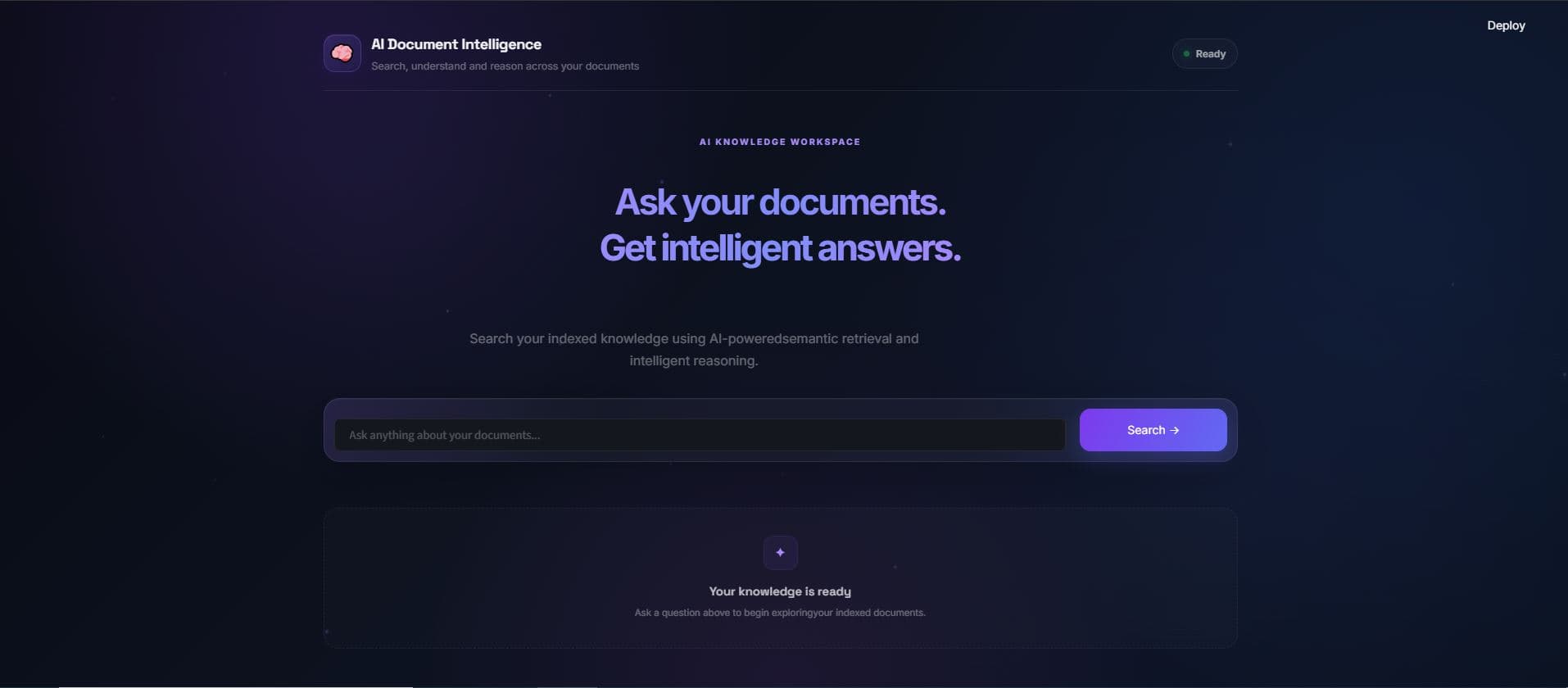
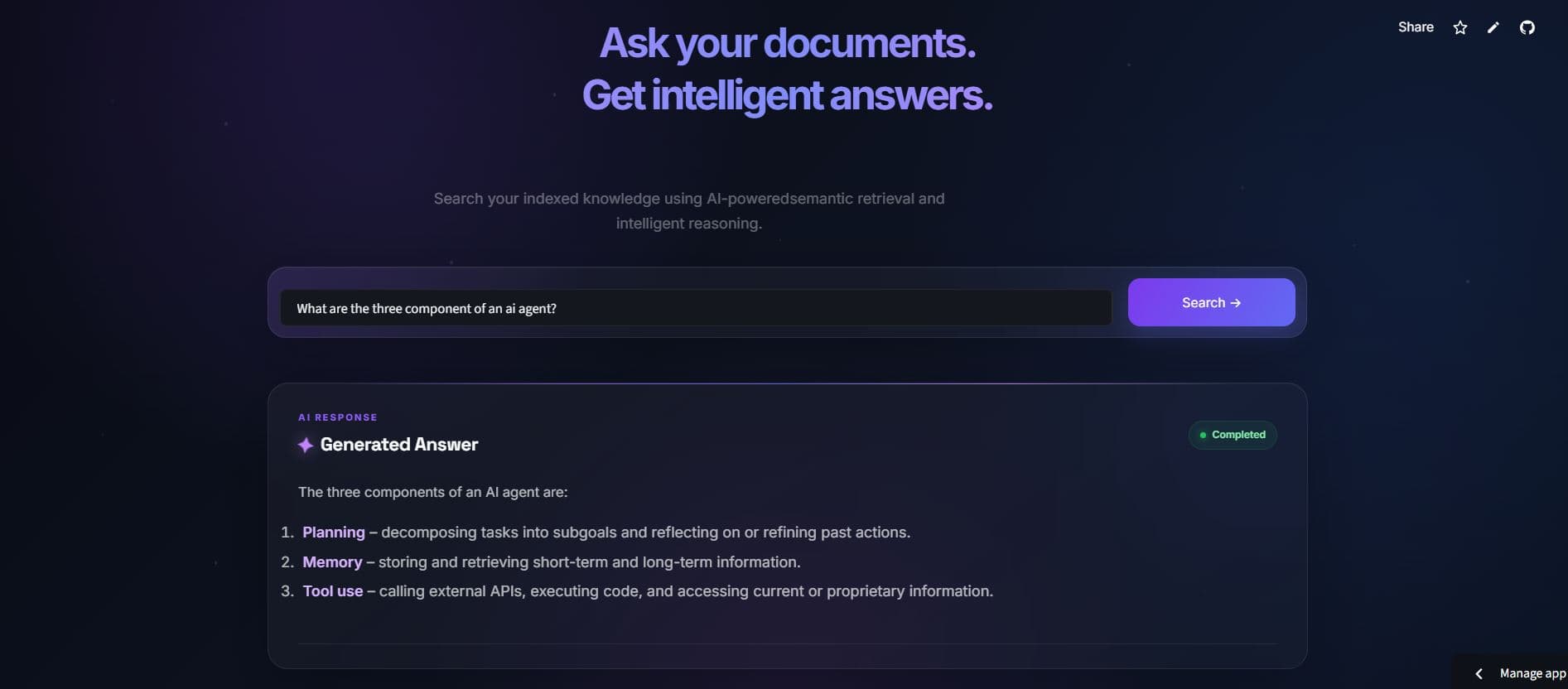
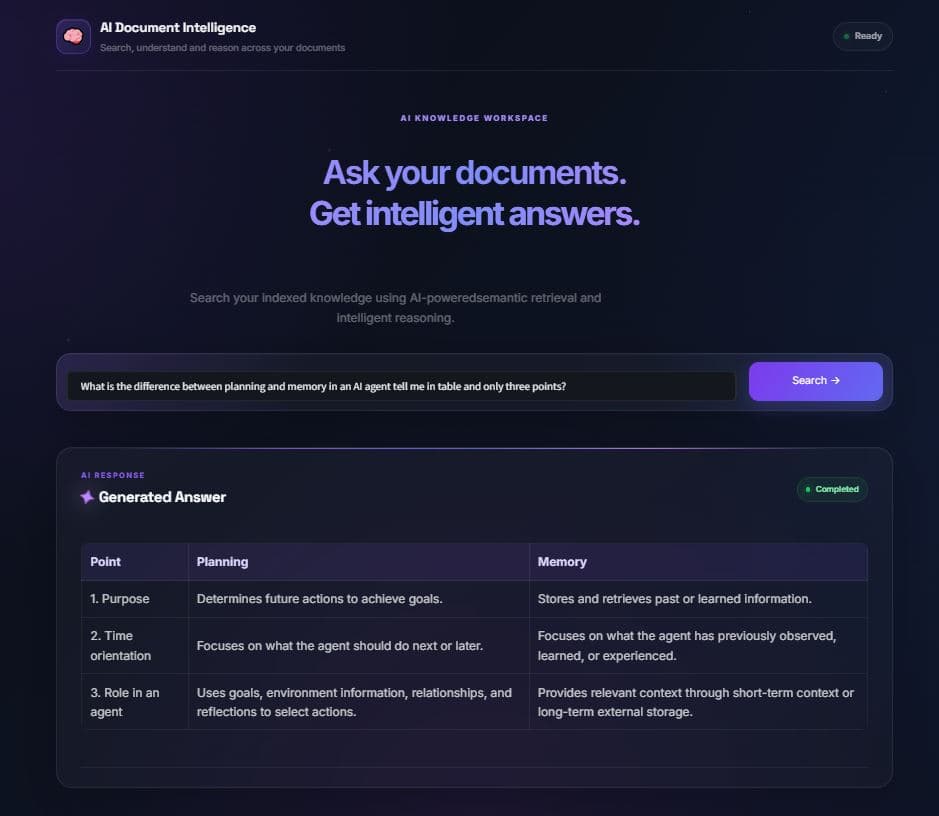
Open the deployed app and test the document-search experience yourself.
How a document becomes a grounded answer.
Each stage has one clear job: prepare the documents, index meaning, retrieve context, and generate the final response from that context.
User question
Hybrid retrieval
Document grading
Context quality check
Query rewrite
Web search fallback
Grounded generation
Streamed response
More than an
LLM text box.
The value is in the retrieval system around the model: document preparation, semantic search, context selection, evaluation, and a usable interface.
Hybrid semantic + keyword retrieval
LLM-based relevance grading
Corrective query rewriting when retrieved context is weak
Tavily web-search fallback for missing local knowledge
LangGraph-controlled RAG workflow
Token-by-token Streamlit response streaming
Context-grounded generation
Retrieved passages are supplied to the model so the answer is based on document context rather than model memory alone.
A focused stack for document intelligence.
A complete retrieval-to-generation product.
The system can detect weak retrieval instead of blindly generating an answer, giving users a more resilient way to search and reason across indexed documents.
Documents become searchable knowledge.
Answers use retrieved passages as context.
RAGAS adds an evaluation workflow.
Designing the system
around the model.
The project moves beyond a basic chatbot by treating retrieval, context quality, evaluation, and product delivery as part of the same engineering problem.
RAG architecture
Designing a complete retrieval-to-generation pipeline rather than a single LLM prompt.
Retrieval systems
Working with chunking, embeddings, semantic search, FAISS, and context selection.
Evaluation mindset
Treating answer quality as something to measure through a dedicated RAG evaluation workflow.
Product delivery
Turning the AI pipeline into a deployed interface that people can actually use and test.
Have documents your team should be able to query?
I build RAG systems, knowledge assistants, AI agents, and document-intelligence applications that turn private information into useful AI experiences.